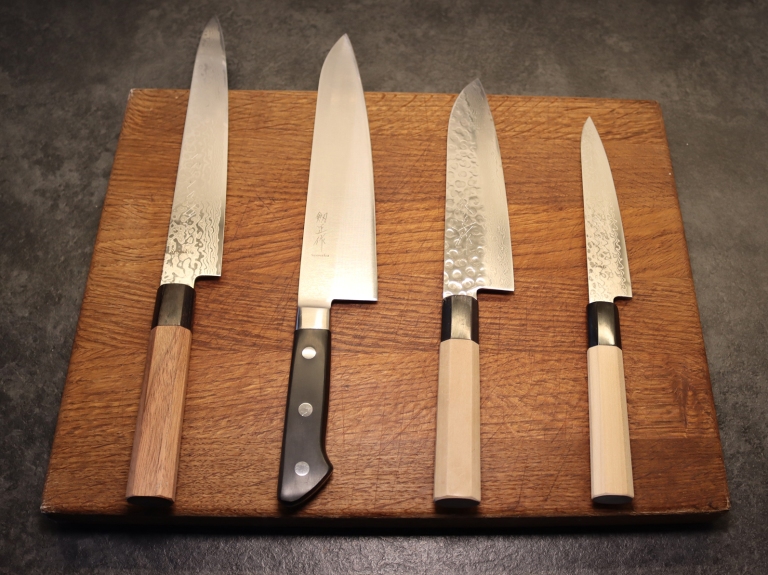
I have just published my long awaited Syosaku kife review on my YouTube channel, so if you love cooking and are looking to upgrade your kitchen knives the video might be a great place to start.
Buying a decent knife these days can be a bit of a minefield, with claims and counter claims, so let me share with you my own experience.
Carbon Steel v Stainless Steel
When I first went to culinary school many knives were made of Carbon steel, which is harder than stainless steel and are easier to sharpen. The downside of these type of knives is the blades do discolour and should not be used with citrus fruits, because it will discolour the fruit as you slice/cut it. You can counteract that by lightly oiling the knife after washing and drying it. If you don’t dry it well it can rust. So in summary carbon steel knives can be an attractive choice and stay sharper longer but can be high maintainance. Stainless steel knives can be used to cut any kind of foods including acidic fruits, but some stainless knives don’t stay sharp very long and are harder to sharpen. So the devil is in the details.
Molybdenum steel
Modern technics have created many different steel alloys that have different hardness and properties such as resistance to corrosion. Molybdenum is a chemical element that has a long history; it was officially discovered as an element in its own right in 1778, and isolated in 1781. Molybdenum steel has excellent strength and mechanical stability. It retains those credentials at extremely high temperatures, and it is both ductile and tough, thus a good choice for knife making.
Damascus Steel
Damascus steel originated from “wootz steel” in India 2,000 years ago. Later in the 4th century AD the term was change to Damascus steel as the city in Syria became renowned for its sword making and metal working. The original recipe for wootz steel has been lost since the 17th century. So modern Damascus steel knives have hard high-grade stainless steel like VG-10, surrounded by layers of other steels to create the characteristic Damascus pattern and enhance durability. This constant folding of the steel produces a knife that is both sharp and the sharpness lasts longer.
As a chef I have owned knives from Germany, France, Switzerland, Japan, UK and even Canada, but even though I have owned some good knives that are not as good or as sharp as my Syosaku knives.
As always I am happy to answer questions if any of my readers need help deciding on a knife.
It is better to own 1-2 top quality knives than have a drawer full of blunt ones that get replaced every couple of years. Owning a great knife makes food preparation easier.
My video talks about and shows how I use my Syosaku knives so I hope you will give it a watch and give me some feedback.
I do have another post about the virtues of using a wooden cutting boards versus bamboo and plastic. And a comprehensive review of my Santoku knife here.
 Chef Kevin Ashton
Thanks Kevin! The knives are beautiful indeed!
LikeLiked by 2 people
Thanks Dorothy and razor sharp.
Best Wishes
Kevin 🙂
LikeLiked by 2 people
My daughter bought me a set of these that I use daily.
LikeLiked by 2 people
Hi Cindy, and thanks for sharing.
What a fantastic present!
Having good kitchen knives makes preparing a meal a breeze.
Best Wishes
Kevin 🙂
LikeLike
Are you saying that my ‘Miracle Blades ‘ as seen on TV may have something to be desired? Please say it ain’t so. Do you think they will honor their money back guarantee?? 🥳
LikeLiked by 4 people
lol……….I always advise people never buy a whole set of knives, just buy 1 good one, the best you can afford. Live with it and then buy more if you are happy with that one knife. Miracle Blades are no miracle, just a rip off, so get your money back.
Best Wishes
Kevin
LikeLike