When I first got into the business, professional chefs and culinary colleges in the UK used wooden cutting boards. But someone decided that wooden boards were not hygienic and decided to replace them with plastic ones, and so the plague of plastic cutting boards began.
In the last few years, however, wooden boards have begun to regain popularity because several University studies have shown that bacteria actually grows slower on hardwood boards than plastic. This is because hardwood has a natural antibiotic property.
Basically, wooden cutting boards kill bacteria. Wood binds up water which bacteria needs to grow. Wood also contains antimicrobial compounds (given that many other plants can be used as natural antibiotics, this is not entirely surprising). Oak showed the highest decrease rate in bacterial titre, followed by beech and ash.
Types of Hardwood
There is a test of wood hardness called the Janka Test but for most people, it is more complicated than the casual observer needs.
Which woods are used for cutting boards can depend on the area of the world you live in; in America, chefs tend to favour Sugar Maple, in Europe we use a variety of hardwoods including Beechwood, White Oak and Rubberwood (also called Malaysian Oak). Ranging from inexpensive Rubberwood or Beechwood up to Teak and American Sugar Maple.
Bamboo
Just to clarify, bamboo is not wood it is a type of grass. The recent fashion of bamboo cutting boards just ‘muddy’s the water’. The seller’s claim it is sustainable, what they don’t tell you is that because Bamboo isn’t a wood, over time the fibres of the bamboo will break off and possibly get into your food. Some bamboo boards are glued together using phenol formaldehyde resin, which can be toxic until cured.
Size Of Your Cutting Board
Since you can not put your wooden cutting board into the dishwasher, you need to wash it by hand. Therefore deciding what size to buy can depend on the size of your kitchen sink. You need to be able to at least get half of your cutting board in your sink to make it practical to clean it. So I suggest a size of about 40 cm (15 3/4″) in length and a depth of about 26 cm (10 1/4 “) and no thinner than 1.8 cm. This is big enough to be practical but still easy enough to manoeuvre to clean. If weight is not an issue then a thicker board that is 3-4 cm thick will last longer.
Types of Wooden Boards
Traditionally, the wood grain on a chef’s cutting ran its length (edge grain), this was thought to be more hygienic and easier to clean. The other type used to be only found in a butcher’s shop and are often referred to as a ‘butcher block cutting board’. Butcher blocks are constructed using pieces of wood with the grain running down (end grain), and were only used in a butcher’s shop because they are cleaned differently. They were salted down to kill bacteria and then scrubbed down with a serious, wire brush to remove the dirty layer of wood.
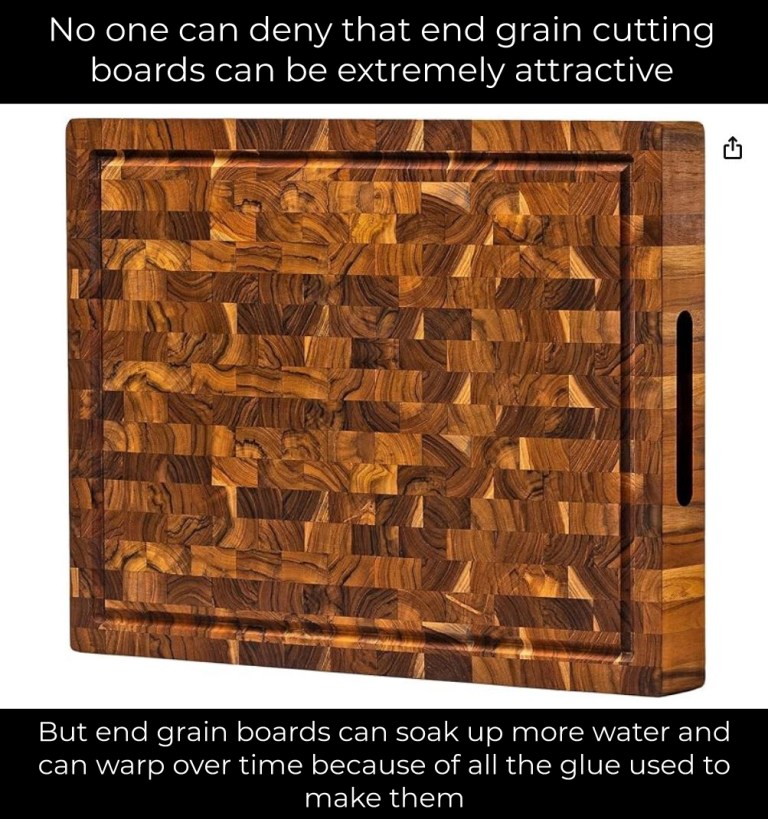
Modern butcher block cutting boards may look attractive, but eventually the glue holding the squares together could come loose (from washing) causing the board to warp. Having the grain run downwards may also help the board absorb more water which you don’t want from a hygiene point of view.
To Stop Your Board From Slipping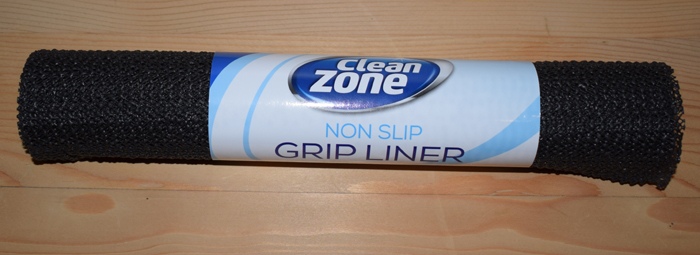
No Rubber Feet:
Don’t buy a board with rubber feet because that just stops you from using one side of the board. Instead, use something like this non-slip rubber mat or even a sheet of paper towel made wet to stop the board from slipping.
Cleaning your Plastic Cutting Board
Plastic and wood have different characteristics, so you have to handle them differently. Plastic cutting boards can be placed in the dishwasher, where they can be sanitised by washing at high temperatures. However, I would still recommend that you first hand wash the board to remove any food debris that might be hidden in the scars of the board before sanitising the board in your dishwasher. Do keep in mind that over time plastic cutting boards can warp in a dishwasher, causing them to not sit flat on your kitchen counter.
Cleaning your Wood Cutting Board
1.) Scrub the cutting board with hot clean soap and water (to get out any food debris in the scratches or grooves on the board’s surface).
2.) Sanitise the board using a mild bleach solution (1 Tbsp per gallon of cold water). I mix the solution and then pour some into a clean empty spray bottle. I spray the clean board, leave for a couple of minutes then rinse well with clean water.
3.) Then pat off the excess moisture with a paper towel and allow to air dry completely (I like to place my clean board on my dish rack, or trivet to allow air to circulate around it).
Reviews
When I decided to write an article about the resurgence of wooden cutting boards I felt it was important to review a couple of boards myself. I did a lot of looking on the internet to try and find a few reasonably priced boards that I would be happy to use myself. I also read a lot of the information and tried to condense this into useful, but not overly long article. You can easily spend £60 to £350 on a large board which is unnecessary.
ChefRemi 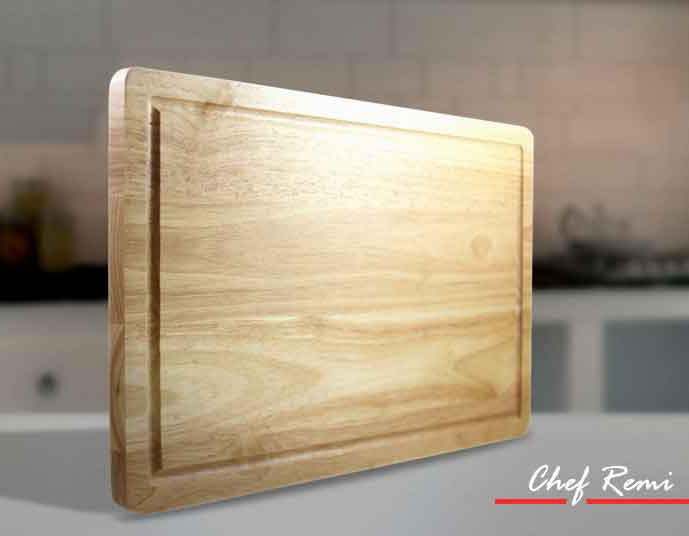
The Chef Remi company state their cutting board comes with a ‘100% Money Back Lifetime Warranty’, which says something about their quality and gives a first-time buyer some confidence in a growing market of cutting boards.
This rubberwood board measures 40cm x 25cm x 1.8 cm thickness
After using plastic boards both professionally and at home it was good to use a wooden board again. This board has a useful groove on one side to capture any liquid
and preventing it from getting onto your kitchen floor.
At £19.95 on Amazon, this might a good board for you, particularly if the weight of the cutting board is an issue and you want something light yet sturdy. The board has a protective coating that makes it easy to clean.
My White Oak Cutting Board when new 2020
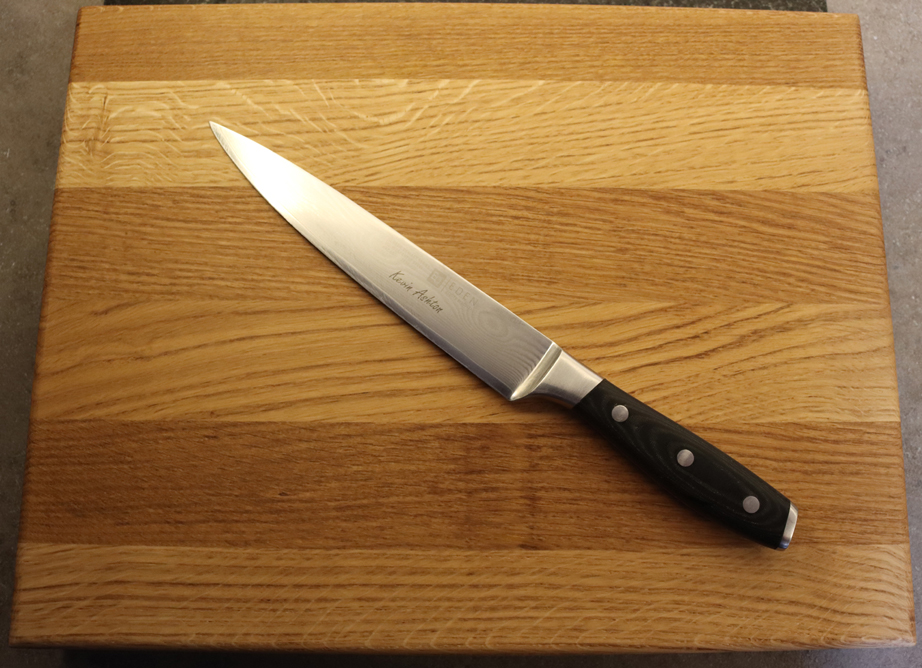
You can see on my edge grain white oak board above, it consists of 6 pieces rather than many smaller pieces or staves.
Ideal size:
When shopping for hardwood cutting boards pay close attention to the dimensions, photos can be deceptive. I recommend you buy a board that you can at least fit half of it into you kitchen sink so you can scrub it. Having a cutting board that is too small can cramp your cutting and lead to accidents. Both of my larger boards measure approximately 40cm x 30cm and about 35mm thick, to prevent warping, as the board ages. So take time and measure your kitchen sink, you will thank yourself later.
I don’t buy cutting boards that have rubber feet on because then you can only use one side.
Update:
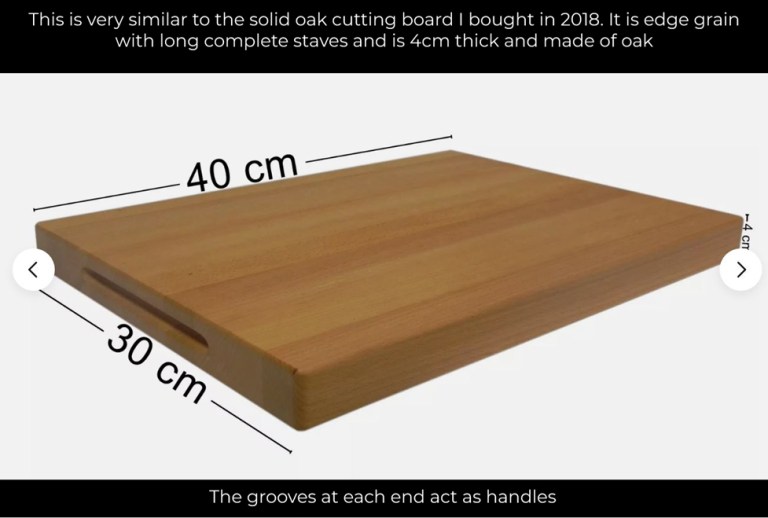
Since first writing the article about wooden chopping boards seller’s prices have risen and even some sellers have stopped producing chopping boards. So rather than find new links that may be out of date, by the time you read this, I wanted emphasize that you should look for edge grain hardwood cutting boards rather than end grain (butcher block type). End grain cutting boards can warp over time if the get too wet, due all of the glue that has been used to stick them together. Don’t forget to follow me on my YouTube channel for lots of recipes and equipment reviews.
Example board I would buy:
Example of a board I would not buy:
Mineral Oil
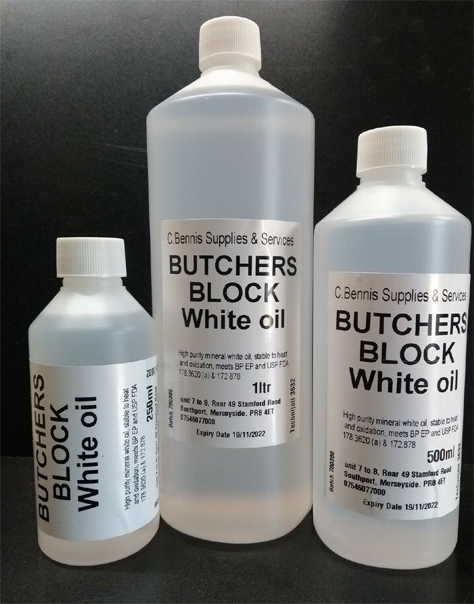
With all wooden cutting boards, it is important to rub them down from time to time, with food grade mineral oil to stop them from absorbing too much water when you are cleaning them. Food grade mineral oil can be relatively expensive, although during my research for this article I did discover that prices vary widely so shop around. Make sure the mineral oil is food grade. I found this one on eBay for UK readers. For American readers there are plenty of choice on Amazon. It is important to store the mineral oil in a cool dry place to prolong its shelf life, if the oil becomes rancid it will need to be replaced. I suggest a 250 ml or 500 ml bottle is plenty big enough (8oz 12 oz) for most people’s needs.
Conclusion
Good cutting board hygiene is the key whatever your cutting board is made of.
Plastic cutting boards over time absorb grease and no amount of runs through the dishwasher or scrubbing can remove all of the grease, plus the scarring and knife marks can potentially hold bacteria. Glass and ceramic can stay grease free but just like plastic they blunt your knives, which can create a different hazard. If you like cooking and keeping your knives sharp then it’s time you took a look and perhaps fall in love with wood. I now have 3 wooden cutting boards, so there is always one clean and ready to use.
Source material:
 Chef Kevin Ashton
Great article Kevin, really interesting to hear your view on this. I love my big wooden chopping board I bought from Ikea years ago and it’s still going strong. Good to know you’ve done all the hard work for me to buy my next one. Thank you.
LikeLiked by 4 people
Thanks Janet for your kind words, they really are appreciated.
LikeLiked by 1 person
Informative, concise and well written.
LikeLiked by 2 people
Thank you for taking the time to give your feedback.
LikeLike
Amazing tips, thanks for sharing!
LikeLiked by 2 people
Thanks chef for your positive feedback, your kind words mean a lot. 🙂
LikeLiked by 1 person
whoa, this is handy. I didn’t know about not putting wood in the dishwasher. woops!
LikeLiked by 3 people
Glad to know my article helped. 🙂
LikeLike
Awesome 🙂
LikeLiked by 2 people
Thank you Aman 🙂
LikeLiked by 1 person
You are Welcome Sir 🙂
LikeLiked by 1 person
Great advice, that come handy, just in time to buy a new board. 🙂
LikeLiked by 3 people
Thank you, I’m glad my article is of use.
LikeLike
Very handy tips and recommendations from an expert
LikeLiked by 3 people
Thank you for your kind words of endorsement.
LikeLike
Great advice thanks you so much!
LikeLiked by 1 person
Thank Diane for your kind words.
Happy New Year.
LikeLiked by 1 person
You’re welcome and Happy New Year to you!
LikeLiked by 1 person
Very interesting and well written!! Thanks for the information
LikeLiked by 2 people
Thank you Alicia, for your kind words, they are appreciated.
Best Wishes
Kevin 🙂
LikeLiked by 1 person
Hey Chef Kebin,
I found all question’s answer I had I my mind about cutting board. Recently I used Bambo cutting board and you know what? I have same thought what you just said about the bamboo cutting board.
I also looked around your other blogs. All these stuff are amazing. I guess I will read your blog regularly.
Thank You
Gias
LikeLiked by 1 person
Thank you Gias, your kind words are appreciated.
Best Wishes
Kevin
LikeLike
Very informative post!
LikeLiked by 1 person
Thank you Twali, for your kind words of support.
LikeLike
I must admit that I’ve always preferred wood, though I can see the attractions of plastic in a professional environment.
LikeLiked by 1 person
Yes, the main attraction in the professional kitchen is cut down cross contamination by colour coding boards. But even so, in the end, it is down to the hygiene practices of the kitchen and the people who work in it.
If they are used correctly but then poorly cleaned and stored plastic boards can still be a hazard. Thank you so much for your thoughtful comment and reading my blog.
Best Wishes
Kevin
LikeLiked by 1 person
This article is really interesting.
Thank you for your suggestions
LikeLiked by 1 person
Glad you liked the article and the suggestions I made about cuuting board choices.
Best Wishes
Kevin
LikeLiked by 1 person
Yes, I love the wood ones!
LikeLiked by 1 person
Me too, much easier to keep clean and kinder to my knives.
LikeLiked by 1 person
❤
LikeLiked by 1 person
Fascinating, Kevin! Maybe it’s time to ditch the bamboo cutting board! Thanks for this helpful post! ❤ Happy holidays!
LikeLiked by 1 person
Glad you found my information about bamboo cutting boards useful.
LikeLiked by 1 person
One of the best and my favorite blog ever and best platform for interesting information.
LikeLike